

The Three Faces of Information
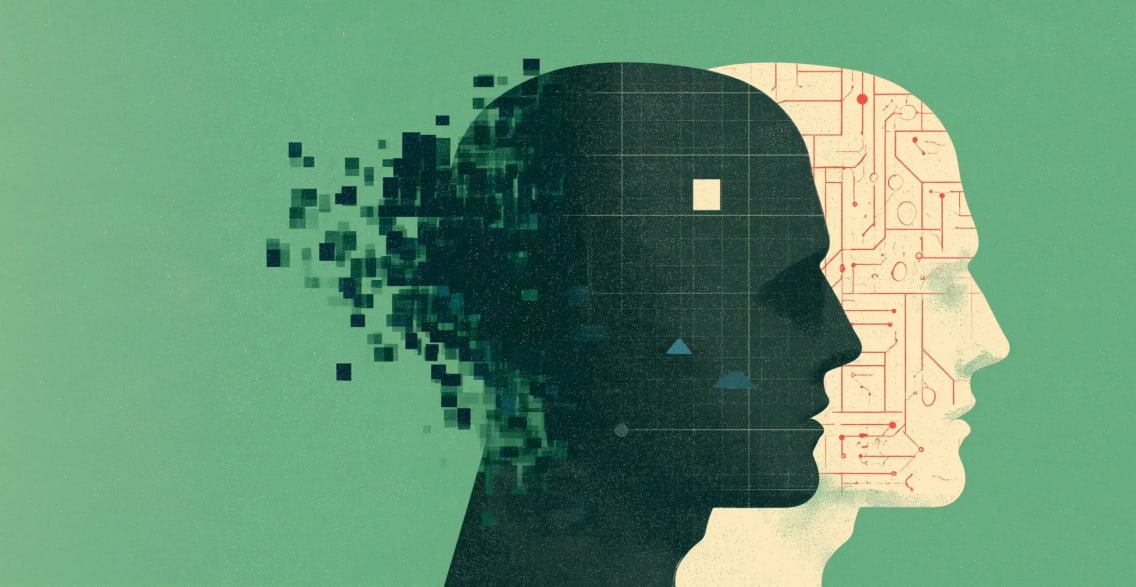
A short primer on complexity, entropy and ambiguity, the vocabulary the essays on this site share
Damian Fozard
Most of the essays on this site rest on one distinction, and rather than restate it in each of them I have set it out once here. It takes about five minutes to read, and it comes from the work Ken Wenger and I have done under the name Cognitive Information Theory, which began as an attempt to understand why artificial intelligence fails in the particular ways it does and became, somewhat to our surprise, a way of looking at minds.
Start with a habit of speech worth breaking. We use the words data and information as though they were the same thing, and they are not. Data is the tidy, storable part: pixels, numbers, words, the material Claude Shannon taught the world to measure and move in 1948, and the material every modern machine learns from. Information, in the sense a mind has to cope with, is larger than that. It includes everything data leaves out, and what data leaves out is not a detail. It is two of the three kinds of thing information can be.
Complexity
The first face is complexity, and it is the learnable one. Complexity is the part of the world that has structure, that repeats, that yields to study. Your phone predicts the next word you will type because language is dense with pattern. You drive a familiar road without effort because you have learned its shape. A radiologist reads ten thousand scans and the eleventh thousand cost her almost nothing. Complexity is not the everyday word for complicated. A thing can be enormously complex in this sense and entirely tractable, provided there is enough of it to learn from. This is the face of information that modern artificial intelligence handles superbly, and there is no reason in principle it should not exceed us here, because there is nothing in complexity that a large enough pattern-finder cannot find.
Entropy
The second face is entropy, and it is the part that will not resolve. Whether it rains on Thursday week. Whether the tyre three cars ahead is about to fail. Which way a fair coin lands. No amount of study makes these predictable, because the world is producing them without a pattern for anyone to catch. The improvability that defines complexity is exactly what entropy lacks. Shannon borrowed the word from physics, and I use it more narrowly than he did: not the disorder of the universe, but uncertainty relative to a model, the mark of where a system’s understanding of the world gives out. Entropy cannot be optimised away. More data will not touch it and a larger model will not touch it, and a system that treats it as a harder case of complexity will keep looking for a pattern that is not there and, because finding patterns is what it does, will find one anyway.
Ambiguity
The third face is ambiguity, and it is the subtlest, because from the inside it feels exactly like entropy and it is nothing of the kind. Someone you love replies to a long message with the single word “fine”. The word is perfectly clear. Nothing about it is noisy or unpredictable. It is nonetheless consistent with several different states of the person who sent it, and the word alone cannot tell you which. That is ambiguity. The world has already decided, and it has not given you enough to work out which decision it made. The sentence “He saw the man with the telescope”, clear in every word and consistent with two different worlds. A shadow on a chest scan consistent with three conditions. A shape at the roadside in failing light that could be a fence post or a deer. A steeply written 1 that could be a 7. In each case the evidence is sharp and it forks, and the fork is in the relation between the world and the observation, not in the observation itself.
Why the distinction matters
Entropy and ambiguity both register as not knowing, and they call for opposite responses. Faced with entropy, the right move is to hedge, to keep more than one future in play, to slow down. Faced with ambiguity, the right move is to notice that several specific readings remain open and to go and get the one further piece of evidence that would settle between them, or to act in a way that is safe under all of them. Collapse either into a single confident answer and you have made an error, but a different error each time, and from the outside the two errors look identical.
Almost every artificial intelligence in use today is a single optimiser: shown an enormous number of examples, scored by one number, and adjusted until the number is as good as it will go. A system of that kind, one objective and one scalar confidence, sees only complexity. It has no way to represent the other two faces, and when it meets them it does the only thing it can do, which is to produce its likeliest answer and attach a confidence score. That score cannot tell entropy from ambiguity, because the information that would distinguish them was thrown away in the act of compressing everything to one figure. For systems of this kind the blindness is not a shortfall of training. It follows from the mathematics of compression, which sheds information about the true cause of an observation and cannot recover it downstream, and it sets a ceiling that no amount of data or scale lifts. That part is proved. Where the ceiling sits for any particular task is a research question.
None of this is news to the people who build these systems, and the field has its own vocabulary for the problem. Machine learning distinguishes aleatoric uncertainty, the randomness in the data, from epistemic uncertainty, the model’s own ignorance, and it has built several ways for a model to decline: detectors for inputs unlike anything in the training set, prediction sets that carry a guarantee instead of a single answer, classifiers that abstain and hand the case to a person. The three faces are not that distinction renamed. Ambiguity survives perfect prediction, which epistemic ignorance does not, and the detectors for unfamiliar inputs catch only one way that entropy can arrive; the entropy that matters most sits inside the distribution or close to it, where those detectors see nothing. The claim of this primer is that a mind reads not only that uncertainty is present but which kind it is and what it means, and the essays below are the case for it.
A mind is a thing that learned, over a very long time, to tell the three faces apart and to respond to each in its own way. It does this not by resolving uncertainty but by governing it, reading the failure of its own model as a signal and changing what it does in response. That is the claim the rest of the site explores, and it is a hypothesis about minds rather than a proof. The part of a mind, or of a machine, that does the governing is what the essays call the second system, because it sits over the optimiser and reads its state rather than replacing it. When the subject is a mind rather than a machine the essays call it the governor; the two words name one thing.
Why Complexity?
The word may seem out of place, since of the three faces complexity is the one we can define, encode and learn, and it is odd to give the tractable part of information the name that sounds hardest. Here is the reason.
Take an everyday object, a baseball cap, say a Toronto Blue Jays cap. On seeing it, anyone can say “Blue Jays cap” and most people will understand exactly what is meant. Now describe the same cap using only primitives: colours, textures such as smooth or ribbed, and shapes such as circle, arc and rectangle, with no words like brim, logo, bird or leaf allowed. It comes out something like this.
A shallow dome of matte royal blue, its surface divided into six curved triangular panels whose points meet at the top in a small blue disc, each boundary between panels a thin raised line of the same blue. From one side of the dome’s lower edge a flat crescent of stiff, smooth blue extends outward, its two ends curving gently downward, its underside a dull grey-green. Just above the join between dome and crescent, a strip of blue stitching runs around the rim in a fine zigzag. On the two front panels, straddling the seam, sits a white shape built from a large arc that opens to the right, a smaller arc nested inside it, and a short blue rectangle rising from the top of the larger arc at a slight angle, tipped with three small triangles. To the left of the white shape, a small red form made of five points around a central stem, outlined in white. Below the white shape, four bold white letters of even height, each a combination of straight strokes and arcs. Inside the dome, six narrow strips of smooth cream cloth meet at the crown, and a ribbed band of slightly darker cloth runs around the inner rim.
That is a great deal of description for a single object, and it is still incomplete. The description is long because the cap is a complex relationship of primitive building blocks: a large number of shapes and colours and textures standing in a particular arrangement to one another, every one of which is present, encodable and, given enough examples, learnable. Nothing in it is random and nothing in it forks. The information needed to identify the cap is all there; it is simply intricate. What a mind does, and what a trained machine does very well, is resolve that intricacy into something simpler, a label, “Blue Jays cap”, that stands for the whole arrangement. Before the label is applied, what you have is complexity. After it, what you have is a name. The word describes the state of the information before it has been resolved, and that is why the learnable face of information is the one that carries it.
Where to go next
For the mathematics behind the ceiling, read The Mathematical Principles of Information. For what the three faces do on their way from the world through a sensor into a model, read The Evolution of Complexity, Entropy and Ambiguity in a Perception System. For why a mind is built the way it is, read Entropy, Ambiguity and the Evolution of the Human Mind. For what the machines cannot do and what would have to change, read The Future of AI and the Path to Artificial General Intelligence. For the essay that started it, read Two Kinds of Not Knowing.
More essays

The terrible job
Your first question

The evolution of complexity, entropy, and ambiguity in a perception system
What sport actually teaches

What AI reveals about human sentience, free will, and creativity

Assessing the Suitability of a Problem for AI

Entropy, ambiguity, and the evolution of the human mind
AI interviews well

The rise of AI consumerism: Living in a world of invisible algorithms

The mathematical principles of information

The future of AI and the path to artificial general intelligence
