

Both Readings True at Once
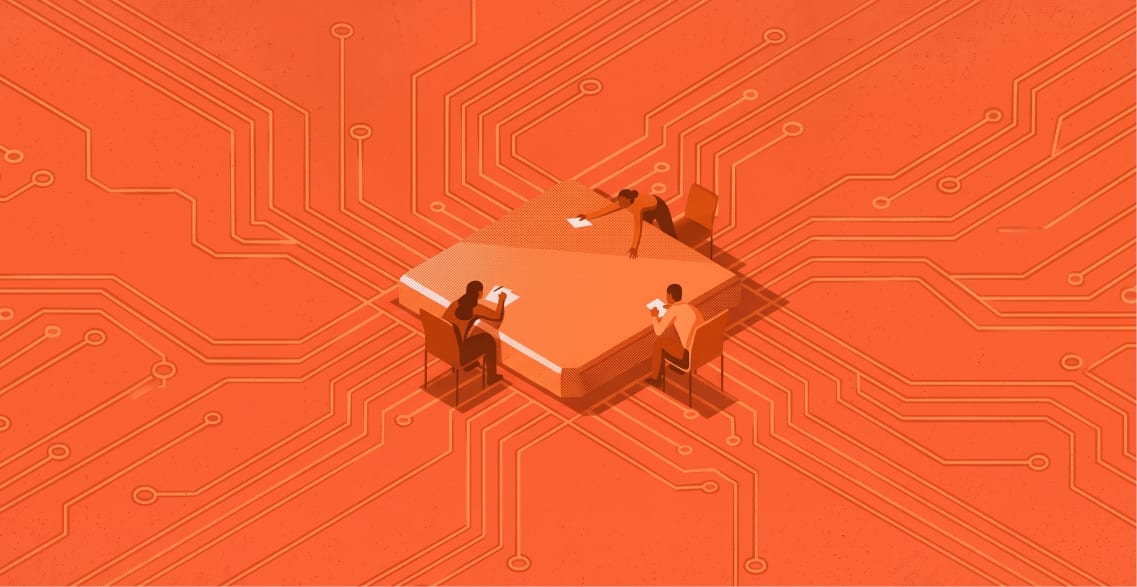
On what artificial intelligence puts at risk, the wage, the school, the working week and the habit of thinking for yourself, and what can be done about each
Damian Fozard
When I had drafted the first version of this essay, under the title The Social Collapse Under AI, I asked a few friends to read it. One of them, Andrew, was kind enough to discuss it with me over lunch, and the point he made was not about the argument. He had read the section on education hoping it would tell him what to say to his children and his grandchildren about finding their way in a world with this technology in it, and it had not tried to. The original essay described the collapse. This one asks Andrew’s question and tries to answer it: what artificial intelligence puts at risk, the wage, the school, the working week and the habit of thinking for yourself, and what can be done about each.
The collapse itself, and why I do not believe this is one, at least not in the way the word assumes, I have set out at length in The Catalogue of Collapses: the weavers and the machine breakers, Thamus refusing the gift of writing, the working week falling by half over two centuries because people fought for the half. That essay is about the shape of the thing. This one is about the particulars, because this has all happened before in its general shape and never before in its particular shape, and the particulars are where both the harm and the opportunity will sit.
The premise is the strongest version of the claim. Jensen Huang has spent several years telling anyone who will listen that the technology his company supplies will remake every category of work he can think of, and that the cost of intelligence is about to collapse the way the cost of computation collapsed before it. Whether he is right about the scale, or right about the scale and wrong about the timing, or wrong about both, is the open question of the next several years, and I have written elsewhere about what the technology can and cannot be trusted to do. This essay sits one step downstream. It takes his claim at something like face value and asks what the cost of being wrong is in each direction. If the tool turns out to be more modest than its advocates promise, much of what follows will have been precautionary. If it turns out to be even half of what they describe, four things that most people take for granted are already in motion: the wage, the school, the working week, and the habit of thinking for yourself. The evidence for the first of these is being assembled as I write. Anthropic publishes a periodic Economic Index of what its model is actually being used to do, in which professions, at which tasks, at what rate, and it is the most serious attempt I have seen to measure rather than assert what is being displaced.
The Weekend App
The misconception running through most of the AI conversation is that AI makes things easy. Anyone, the line goes, can write an app in a weekend. Anyone can build a website. That part is true, and it is the part the headlines have noticed. The part that is missed is the next sentence. The app written by a hobbyist with an AI in a weekend will reach a level of quality that, two years from now, will be the floor and not the ceiling. The website built to rote by an AI will be indistinguishable from the thousand others built to the same rote. What AI offers the people who go past the weekend version is the same thing every previous productivity tool offered the people who learned to use it past the threshold of common competence: the same hour of human judgement and invention, multiplied by a machine that does more of the rote work than any machine before it. The opportunity is not closed by AI. It is concentrated. The phasing is not difficult to predict, though the rate is. First, everyone uses AI to a level. Second, that level becomes the baseline and commoditises quickly. Third, the people who can build the better app, design the better process, ask the better question of the model, become more valuable than they were, not less. This is the pattern that played out for typists, draughtsmen and bookkeepers when their tools went general-purpose, and I have not yet seen a strong argument for why this case is exempt.
The same logic plays out at the level of the firm. Adoption begins as a defensive move, a small first-mover advantage that competitors notice and shortly imitate. It becomes a survival step inside another year or two, when quality, pricing and delivery speed in the industry have shifted because the firms that adopted first have changed what customers accept as the baseline. There is nothing structurally new in this. Amazon did it to the mall: a small advantage in the late 1990s became a competitive necessity a decade later, and a survival question for whole categories of retailer in the decade after that. What AI is going to do to administration, bureaucracy and business process is what Amazon did to physical retail, and the firms that wait for the survival question will discover what the malls discovered, that the moment to act was several years before the moment when action became urgent.
There is a complication that pulls the other way, and the public conversation does not yet take it seriously. Whatever AI is doing to the demand for skills, it is doing inside an economy that is also being pulled in the opposite direction by forces nobody in 2007 had on the board. Globalisation, which spent 30 years moving labour-intensive work to wherever it was cheapest, is retreating. Onshoring, friend-shoring and the return of industrial policy, the polite name for tariffs, are pushing categories of work back inside national borders, often at higher wages. When a country offshored an industry it did not only export the jobs. It lost the suppliers, the apprenticeships, the trade schools, the local engineers who knew which factory could solder which board on a tight schedule, the half-formal network of people who had grown up inside the work. That layer is invisible until it is gone, and the estimate I have heard most often, from people who have tried, is something like 30 years to put it back: long enough to reskill a workforce, retrain the supervisors, rebuild the supply chain and produce a generation of engineers who can do the work without a foreign manual at their elbow. Thirty years is not a political timetable. It is barely a generational one. What AI offers at the country level is the only realistic offset I can see to that arithmetic, not as a substitute for the skills that were lost but as a force that lets the rebuilding be cheaper and faster than the thing that was given up. The two effects, AI compressing some wages while a re-regionalising economy bids others up, do not cancel tidily, and the people whose skills sit at the intersection are not always the ones who can move across it.
Force, Not Speed
It is difficult to understand the AI force multiplier without experiencing it. The phrase has been used so often in product marketing that it has begun to mean nothing, which is a shame, because it names something real that almost nothing in the previous productivity literature quite captured. Two examples from my own working life, taken apart, show that the public conversation has been describing the wrong dimension of what the multiplier does.
The first is mundane. I travel a great deal, often four or five meetings across three or four cities in different time zones, against the constraints of a calendar I cannot quite remember the contents of without checking. Until 18 months ago, planning these trips was a sustained piece of work: an evening set aside, four browser tabs, the calendar, a conversation with my assistant, and a slow assembly of an itinerary that did not have me arriving at a board meeting in Frankfurt the morning after a red-eye from Toronto. The trip now begins with a sentence spoken into the agent on my laptop.
“I want to leave on my trip to Europe on the 23rd or the 24th, with enough time to recover from the jet lag before the first meeting. Look at my calendar. There are four meetings in different cities. Plan the trip. Convenient hotels near each meeting. Prefer direct flights.”
I close the laptop. The agent reads the calendar, sees the meetings, knows the existing constraints, queries the airlines and the hotels, and comes back 40 minutes later with an itinerary I look at for two or three minutes before approving. Thirty seconds of work on my part has produced what would, a year ago, have taken between three and five hours of mine, my assistant’s, or both.
This is, in narrowly economic terms, trivial. The interesting case is what happens when I point an agent at something the firm actually needs. “Prepare me a report on the cash-flow movements across the last four quarters, with sensitivities.” “Build me a Monte Carlo model that tests the current sales pipeline against the last six quarters of close data, and tell me which assumptions are most fragile.” Each of those requests, three years ago, would have taken a senior analyst three to five working days, longer if the data was scattered. They now run in minutes, and produce work I would have been pleased to receive from a strong analyst at the end of a week.
The interesting variable is not the time. It is what the information enables once it arrives. The Monte Carlo model that took three days used to be commissioned once a quarter, because the cost of commissioning it ruled out doing it more often. The same model produced in minutes can be commissioned weekly, daily, on the morning of a board meeting, on the evening of an unexpected request from a customer. The decisions a firm can make on fresh, model-grounded information are not the decisions it can make on stale, intuition-grounded information. The strategic surface a firm can operate on widens, often by an order of magnitude, when the cost of producing the inputs to its decisions falls by an order of magnitude. The force multiplier is not in the saved minutes. It is in the new economic actions the saved minutes make available. The reason a small AI-augmented firm can compete with a much larger incumbent is not that the small firm is faster at the same activities. It is that the small firm operates on a strategic surface the large firm cannot reach: the large firm still commissions its quarterly model, and the small firm is running it continuously, against fresher data, and making decisions on information the large firm will not have for another nine weeks.
There is a qualifier, and it is the part the companies selling agents do not advertise. The multiplier only works in the hands of someone who can unleash it. The same agent, the same minutes, the same model, produce very different output depending on who is operating them. A junior analyst with an agent produces faster mediocre work. A senior strategist with the same agent produces faster excellent work, more of it, and at a level of fluency the strategist could not have reached inside a working life. The multiplier multiplies what was there. It does not create what was not, and the implication, uncomfortable for the buyer, is that AI is most valuable to the people who least need it.
The field studies say, at first sight, the opposite, and they deserve their strongest form. Erik Brynjolfsson, Danielle Li and Lindsey Raymond, studying customer-support agents given a generative assistant in 2023, found the largest gains among the least experienced workers, and the studies of writing tasks and consulting tasks that followed found the same: the tool lifted the bottom of the distribution most and the top least. I accept the finding and I do not think it contradicts the qualifier, because the two are measuring different things. Those studies measure bounded tasks, a support ticket, a memo, a marketing brief, where the model’s output is close to the ceiling of what the task can be, and there the machine raises the novice to the machine’s level. The multiplier I mean operates where the model’s output is the floor: where the question is which model to run, against which data, to decide what. Compressing the bottom of the distribution and stretching the top are both happening, and the weekend app is the first, and the strategic surface is the second, and the people in the middle, whose skill was to do bounded tasks well, are the ones the compression reaches first.
The cleanest example in recent business history is Blockbuster and Netflix. In 2000, Blockbuster was the dominant force in home video rental, with several thousand stores, billions of dollars in revenue, and a brand the customer could recite without thinking. Netflix was a small mail-order DVD start-up whose founder, Reed Hastings, offered to sell the company to Blockbuster for $50 million and was laughed out of the meeting. The transformative technology was not anything exotic. It was the internet, applied first to the logistics of DVD distribution and then, when bandwidth caught up, to streaming. Blockbuster could see the same internet. It could read the same trade press. It could have built the same product. It did not, partly because the rental-store model was the source of its current revenue, and partly because the people who would have had to lead the change were, structurally, the people whose careers had been built inside the old one. By 2010 Blockbuster had filed for bankruptcy. By the end of that decade Netflix had passed the entire United States cable industry in subscribers. The mistake was not technological. The incumbent could not bring itself to operate on the strategic surface the new technology made available, and a much smaller firm could and did.
The larger version of this story sits in my own working life. The vision I am acting on at Squint Cognition today is the vision I was acting on at CoreAVI, the avionics software company I spent 20 years building: the certification pipeline is a long sequence of administrative steps, each with its own people, its own governance and its own queue, and the right place to apply generative AI was always the whole sequence. I could see that clearly at CoreAVI. What I did not have was the capability to deliver it, and my attempt to optimise one step won a quarter of the cost of that step and then plateaued; I have told that story in full in The Sixty Per Cent. The product the vision was pointing at now exists. Squint AeroCert replaces the eight steps with a single AI-driven flow, the AI doing the bulk of the procedural work and a much smaller number of people operating at the points where the judgement actually lives. Squint could do this because, as a start-up, it had no teams and processes built around the eight steps; it could address the whole process rather than the process as seen through the lens of individual teams.
This is the force multiplier at the level of the firm, viewed from the inside. The small firm with the new flow is replacing the work of considerably more than one team in the incumbent firms. The output is the same output, the process unrecognisable; the work product is better and the cost is a fraction of what it was. The people currently doing those roles do lose out, and that cannot be waved away by reference to creative destruction. They are losers in a quite specific sense. Their decade of training inside the eight-step model is now worth less than it was last year, and the wage they can command for it is falling, in real terms, while I write this. The catalogue applies to them as squarely as it applied to the framework knitters of 1811, with one difference. The Luddites had perhaps three decades to feel the compression. The administrative incumbents of the certification industry are feeling it inside a window that has been measured, in my own experience, in two or three years.
What Is School For
The phrase I want at the front of this section came from a college professor I had nearly 30 years ago. He was not a remarkable man in the conventional academic sense. What he had was a fierce conviction about what the room was supposed to be doing in his classroom, and a willingness to tell it when it was not. The line he came back to, when the discussion had wandered into received opinion or comfortable shortcuts, was always the same:
“The rigour and discipline of our craft.”
A college professor of mine
He was right then and he is right now, and the reason I want him at the front is that the question Andrew was asking me over lunch is not really an AI question. It is a much older question that the arrival of AI has finally made unignorable: what is school for. The society has been postponing it for at least a generation, because the answer that worked most of the time was “school is for getting a job,” and the jobs were arriving reliably enough that no further answer was required. The jobs are now in motion, and the old answer is collapsing under the strain. The AI conversation is the surface of that collapse, not the cause of it.
The most fashionable answer in current circulation is that the plumbers and the electricians will thrive, because their work cannot be done by a model, and that the rest of the educated population should brace itself. I find this less satisfying than the people offering it appear to. The manual trades will be slower to be touched, but they are protected by deployment economics, the cost of fitting a robot to a domestic boiler being high and staying high for a long time, rather than by anything that resembles the structure of the skill. The trades are not exempt; they are slow. More to the point, which trade will survive is the wrong question. The interesting question is which disposition will thrive, and that one is far more relevant to the parents asking.
There is a precondition that gets routinely skipped. For anyone to do well inside an economy, the economy itself has to thrive. The most carefully designed education, producing children with exactly the right dispositions, cannot rescue a country whose industries have shrunk to the point where there is no room for those children to use them. Most national AI strategies I have read are doing the wrong thing for the wrong reason: treating AI as a category of technology to be funded, a budget line, a few institutes, a flagship project and a press release, when the right product is what the country wants to become inside a regionalised and more contested world economy, with AI as the means. The outcome that produces industries rather than policy papers rests on three unglamorous things. The first is an AI-literate business leadership, not the executive who can name the model of the month but the cohort of chief executives, operating officers and middle managers who understand at a working level what their own operations would look like after a serious rebuild, and who can make capital decisions on that basis without a consultant in the room; that cohort cannot be conjured by a training programme and has to be grown, by exposure, over most of a decade. The second is patient capital that matches the leadership, of the kind infrastructure projects receive and AI initiatives largely have not. The third, which decides whether the first two arrive, is a credible signal to the markets that the strategy will survive the next election. Education sits one step downstream of all three. The country that gets this right produces the demand into which the new education feeds; the country that does not produces a generation educated for industries that are no longer there.
Inside an economy that is thriving, what AI does to the value of skill is not to abolish it but to reweight it. Knowledge is not made obsolete. Skill is not made obsolete. What changes is the relative price of different kinds of each, and the change is large. Two dispositions rise sharply in value. The first is critical thinking, by which I mean the capacity to take a confident-sounding output and ask whether it is true, whether the framing is the right one, whether the evidence has been weighed fairly. The second is creative thinking, the capacity to produce an answer the model has not been asked for, that the room has not been told to expect, and that turns out to be useful precisely because it was not in the training data. These are old categories, undervalued by most school systems for as long as I have been watching school systems, because they are difficult to test cheaply and the systems have been organised around what is cheap to test.
There is a third class of skill my professor was naming when he talked about the rigour and discipline of the craft, and it is the one most underweighted in the current conversation. Critical and creative thinking on their own, without a discipline behind them, produce confident dilettantes. The combination that wins is critical thinking, creative thinking, and the steady capacity to do the work slowly and properly, against the temptation to take the model’s first answer and move on. Shaping a thought through a connected web of knowledge while the machine is generating, suggesting and occasionally hallucinating is a skill, and it is the skill that almost nothing in the modern educational metric is designed to develop.
I used to say that I did not have the curriculum, and I remain suspicious of anyone who claims to, particularly the technology companies whose business models depend on selling one. What I have found since, writing about belief for a younger reader, is that I do have the test, and that somebody has already run it. The test is whether what a school teaches could survive its own lessons: whether the children are handed the tools of checking, and whether the tools are warranted for use on everything, including the school. The existence proof is Finland, which has had media literacy and critical thinking on the national timetable from the earliest years, woven through the curriculum as a basic skill like reading. Finnish children examine claims from videos and social posts, compare clickbait framings of the same story, study the famous propaganda campaigns and the ways statistics can be dressed to mislead, and, best of all, are set to write fake news themselves, because nothing teaches the trick like performing it. Finland has sat at or near the top of the European Media Literacy Index, a ranking of countries’ resistance to false information, repeatedly since 2017. I do not offer this as a policy proposal. I offer it as proof that the thing can be taught, that thinking for yourself is a subject with homework, and that a curriculum which invites children to doubt the curriculum survives the invitation. My professor’s rigour and the Finnish classroom are the same point seen from two ends.
The parents and teachers in my circle are at risk of getting two things wrong. The first is that they treat the AI question as a question about technology, when it is a question about the purpose of school. The second, which worries me more, is that they tend to double down on the part of the curriculum the AI does most cheaply: more memorisation, more procedural execution, more formulaic writing graded against a rubric the machine can hit at the press of a button. That produces a generation of children who are the machine’s competitors in the wrong race rather than its operators in the right one.
The Half That Comes First
The fourth construct is the one the catalogue has no entry for, and it is the reason I do not think the historical analogy, useful as it is, carries all the way.
Every disruption in the catalogue took the work out of people’s hands. The loom took the weaving, the threshing machine took the winter labour, the spreadsheet took the bookkeeping. What none of them offered to take was the judgement about what the work was for and whether it had been done right. That is what is on offer now, and it is on offer in a form that is very hard to refuse, because it is pleasant. The summary sits above the search results. The assistant drafts the reply. The agent plans the trip, and I close the laptop. Every one of those is a delegation, and most of them are good delegations, and the multiplier I described above is built out of nothing else.
Plausibility, meanwhile, has become free. For the whole of human history a convincing document told you that somebody had spent time, money or skill to make it, and that small reassurance was doing more of the work of trust than anyone noticed. It has gone. Anything plausible, words, pictures, voices, a study, a record, can now be manufactured in seconds, which means plausibility is worthless as evidence, and the habits that were once the scholar’s, checking the premise, tracing the source, holding two stories open at once, have become practical skills. I have written about the mechanism in The Plausibility Machine and will not repeat it. What belongs here is the consequence for skill, because it is the same reweighting as the one in the last section seen from the other side. The people who can tell reliable information from noise will become more valuable, not less, and the people who cannot will be the cheapest thing in the economy, because the machine already supplies fluent confidence at no charge.
The two facts together are the modern construct that is under threat, and I would name it as the habit of thinking for yourself. Agency has two halves, and the order matters. Acting for yourself is the visible half. Behind most consequential acts there is a thought about what is possible and permitted, and if that thought was installed by someone else, the act belongs to them, whoever’s hands are on the wheel. The machines do not threaten the visible half; they multiply it. They threaten the half that comes first, by offering to supply the thought, fluently and for free, and by learning what you already believe and giving you more of it. The junior analyst whose faster mediocre work I mentioned above is not lazier than his predecessors. He has been handed a tool that does the thinking part of his apprenticeship for him, and the apprenticeship was where the judgement used to get built. I have written in The Boundary Without a Line about what the agents do to the years in which the next senior people would have learned to set the boundaries the agents cannot see, and the point applies here with more force, because those years are also where a person learns to notice when the thought was not their own.
What can be done about it is smaller than a curriculum and more demanding. Delegating decisions to rules and to people we trust is not the failure; nobody could work without it, and a person who reopens every settled question becomes exhausted, unreliable and easy prey for the first conspiracy that flatters their doubting. The failure is not knowing that the delegation happened, or what would justify taking the decision back. That is the discipline I would ask of anyone putting an agent to work, and it is one I am still learning. When I approve an itinerary after two minutes I know what I am delegating and I know what would make me take it back, a meeting I had forgotten, a hotel in the wrong city. When a firm approves a model’s analysis after two minutes it needs to know the same things, and most do not, and the machine will not tell them, because telling them is the one thing it cannot do. Deep reading, slow checking, the willingness to leave a satisfying story unresolved: these were once the scholar’s habits and are now the operator’s, and a school that teaches them is doing the only thing the catalogue cannot do for a child.
The Time Dividend, Again
The working week is the construct the catalogue is most reassuring about, and it is worth saying briefly why, and where the reassurance stops.
The conversation about the four-day week is now several years old and does not require AI to make sense. The Icelandic trials between 2015 and 2019 moved a substantial part of the public sector to a 35- or 36-hour week without loss of pay. The United Kingdom trial in 2022, run across 61 companies and around 2,900 employees, ended with the great majority of firms keeping the change. Spain piloted it. Belgium, in the same year, gave employees the right to compress their hours into four days, which is a different thing and is often reported as though it were the same one. The discussion is older than the chatbot, and it would have continued without anyone hearing the word “transformer” in its current technical sense.
Artificial intelligence does not change this picture in any fundamental way. On the most generous reading of its likely effects it is the next term in a series that has been running for two and a quarter centuries. The surplus it releases will be banked, like the previous surpluses, in three places: in wages, in the capacities of firms that did not exist before, and in time the worker no longer has to sell to live. The political question is not whether the third of those will happen. It is what proportion of the surplus arrives there, and how quickly, and it will be answered by the same combination of legislation, organised labour and the disposition of capital that has been answering it since the Factory Acts. It will not be answered by the technology, any more than the steam engine answered the question of the ten-hour day. The reason I am, on balance, more hopeful than not about this thread is that the developed economies, when allowed to answer across generations, have consistently converted some of the new capacity into time, enough that a worker in 2000 sold less than half the hours a worker in 1800 did. The same direction, applied to whatever AI releases, would carry the week into the 30-hour range within a generation, which is what the careful advocates of the four-day week are already arguing for on the existing evidence. The reason for caution is the one the catalogue gives: the conversion has only ever happened where the politics allowed it, and the people who would prefer it not happen this time are at least as well organised as their predecessors.
Both Readings True at Once
There is one tension under all four threads that this essay does not resolve, and should not. The force that lets a country rebuild an industry cheaply, and the force that lets a small firm hollow out a large one, and the force that hands a child a tutor and a clerk a thinking machine, are the same force. The country reads it as opportunity. The displaced incumbent reads it as competition. The people inside a trade whose wages are quietly halving over the decade in which all of this is happening read it as something else, and the child whose apprenticeship it has foreshortened will not know what to read it as for another 20 years.
The country that gets its strategy right will count its new firms, its new exports, its renewed infrastructure, and will conclude, correctly, that the bet paid off. The worker whose trained skill is worth two-thirds of what it was a decade ago will not be made whole by the country’s exports, and will be correct about that too. Both readings will be true at the same time, and the body of this essay has tried to live inside that contradiction rather than escape it. What I would tell Andrew’s grandchildren, since he asked, and their parents with them, is the plain thing: that the machine will do most of what the school and the course are teaching, from the first classroom to the last, and none of what my professor was teaching me, and that the second half of the education is the half they will have to insist on.
More essays

The terrible job
Your first question

The evolution of complexity, entropy, and ambiguity in a perception system

What sport actually teaches

What AI reveals about human sentience, free will, and creativity

Assessing the Suitability of a Problem for AI

Entropy, ambiguity, and the evolution of the human mind
AI interviews well

The rise of AI consumerism: Living in a world of invisible algorithms

The mathematical principles of information

The future of AI and the path to artificial general intelligence
