

Beautiful and sublime things
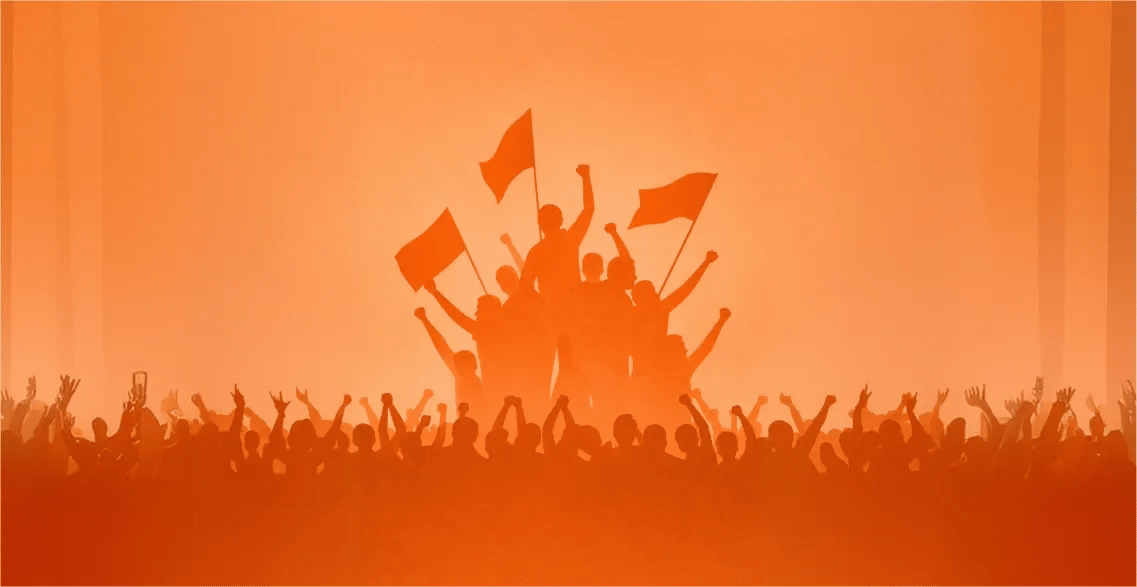
On extreme patriotism, conscription, and what we lose when the right to disagree is taken for granted
Damian Fozard
I have lived under three flags, and each asked something different of me. In England, where I grew up, the flag was mostly left to football crowds and to the people one crossed the road to avoid, and love of country was expressed by complaint. In the United States, where I worked, the flag was on the porch and the anthem came before the game, and the hand went to the heart without anyone thinking about it. In Canada, where I live now, the feeling is quieter and mostly defined by what it is not, until a hockey final or a trade dispute brings it out, and then it is not quiet at all. None of the three felt dangerous. None of the three is what a state can make of it, given enough years.
Patriotism is not the same as love of country, and nationalism is not the same as patriotism. They are belief systems, each separable from the others, and each capable of being shaped, intensified, and weaponised by the people running the country at any given time. The danger is not the affection one feels for a place or a people. The danger is what a state can do with that affection when it has been compounded across enough years.
In Disbelief, which I published in 2025, I wrote about belief and the social domains in which it must be set aside. One of the chapters concerned agency: the human capacity to act, to choose, and above all to refuse. I return to that material here because two cases, one historical and one contemporary, illustrate the same mechanism at different stages of its development, and a third question (what becomes of agency when the global order shifts) is now actively at stake.
The historical case is the Japanese tokkotai, the suicide units of the Second World War. The contemporary case is the North Korean soldiers deployed by the Kim regime to fight, and to die, in Russia’s war against Ukraine. The third is what we lose, in a low-trust world tilting back towards regional power, when the right to disagree with one’s government is no longer assumed.
I. The Kamikaze
Somewhere between 3,800 and 6,000 young Japanese men, depending on what is counted, were killed in tokkotai missions in the last phase of the war. They flew aircraft, rode manned rockets and torpedoes, drove explosive boats and submarines, and in some cases walked into the sea wearing bombs. From a military perspective, the missions were often ineffective and at best postponed the inevitable. Some of the pilots knew this. In one exchange recorded by the historians Albert Axell and Hideaki Kase in Kamikaze: Japan’s Suicide Gods, a young naval officer, about to board his kaiten, a crude human-steered suicide torpedo, told a newly enlisted man that Japan would certainly lose the war whatever anyone did. The man asked why, then, he had volunteered to die. The officer’s reply was this:
“A man must do what he can for his country.”
The letters home are the most affecting record. Corporal Takao Adachi, who was 17 years old when he flew from Giran airfield in Taiwan to his death on 1 June 1945, wrote to his father and grandmother on the eve of his sortie that he was “absolutely satisfied that I have a good place to die.” Ensign Teruo Yamaguchi, who was 23 and died three weeks later, wrote that Japan’s national identity was a “beautiful and sublime thing” and that he must protect “with honour these beautiful and sublime things.” Both letters were kept by the families and the Chiran memorial, and are translated in Bill Gordon’s Kamikaze Images archive. One can debate, and historians do, how freely those letters were written, what social pressures shaped them, whether the volunteers were truly volunteers. The individual question, however, does not change the structural one. A society had been built that could ask young men to do this, and could expect them to comply.
The structural answer goes back to 1868. The Meiji reformers spent six decades constructing a national identity in which the emperor was a divine figure, the Japanese state was sacred, and individual life had its meaning in service to both. Buddhism was repurposed. Shinto was split into a household religion and a state religion, the latter described by scholars as a newly concocted religion of ethnocentric nationalism. The 1937 Essence of Kokutai declared the emperor a living god in writing. By the time Adachi wrote his last letter, the idea that he should sink himself into an Allied ship was not an outlier. It was the natural conclusion of nearly 80 years of patient state-building. The point is not that the pilots were brave or foolish. The point is that no one engineered this in a year. Extreme patriotism is the compound interest on belief.
II. The Conscript
The North Korean soldiers now deployed to fight in Russia look superficially similar to the kamikaze. They look very different on inspection.
By the autumn of 2024, some 11,000 soldiers from elite North Korean divisions had been deployed, primarily to the Kursk front in Russia, and reinforcements over the following months took the total towards 15,000. Casualty estimates have varied. British defence intelligence put killed and wounded at more than 6,000 by June 2025, around half the original force; the South Korean intelligence service put deaths at about 2,000 by that September. Ukrainian sources reported that North Korean units had conducted human-wave assaults with little effect against Ukrainian positions, and claimed, without independent confirmation, that Russian forces had on more than one occasion opened fire on retreating North Korean troops to prevent their capture. North Korean officers were reported to be doing the same to wounded comrades. The motive given was that a captured soldier might reveal North Korea’s involvement, and that a captured soldier’s family at home would be punished.
This is not the kamikaze. The kamikaze was the climax of an 80-year compounding of belief in the country he died for. The North Korean conscript is a different transaction. The Kim regime is paid in foreign currency and military equipment for each soldier it supplies. The soldier himself is the product. He has not been convinced that his country is divine. He has been told that he will be shot, or his family punished, if he does anything other than what he is told.
The Russian side of the same war makes the contrast plainer. In 2022, when Russia tried to conscript its own young men, hundreds of thousands left the country in the days before the order took effect. The most searched term on the Russian internet during the conscription weeks was “How to break your own arm.” The Russian state had not done the work of compounding the belief. It had asked too quickly for too much, and the population would not pay.
The kamikaze and the North Korean conscript bracket the spectrum. At one end, the individual believes. At the other, the individual is held. A regime does not need belief if it can supply the threat.
III. Agency
In Disbelief I argued that agency, the human capacity to act and to choose, is the most fundamental of our traits, and the one most often contested. Agency is not an abstract ideal. It is, in the chapter’s own phrasing, a battleground. Every society, every institution, and every ideology engages in an ongoing negotiation about its limits. The abolition of slavery, the most consequential moral correction of the modern era, was driven not by the architects of the system but by people whose agency had been forcibly denied, and by others who held their society to account on those denied people’s behalf. Their dissent was costly. It altered the moral fabric of the world they lived in.
What the kamikaze and the North Korean conscript have in common, despite the structural difference, is that their agency was the price of admission. The young man writing a letter about beautiful and sublime things had been raised to find no other answer. The young man being marched into a human-wave attack was being held at gunpoint by his own officers. In either case the question of what he wanted is not a question the system was prepared to ask. In a fair and just world the most basic protection against this is the assumed right of the individual to disagree with the government that claims him, and to remain a citizen of that government afterwards.
The obvious objection to all of this is Ukraine, and it should be met rather than avoided. Ukraine conscripts. Men of military age have, with narrow exceptions, been barred from leaving the country since February 2022; the mobilisation age was lowered from 27 to 25 in 2024; the recruitment officers who pull men from the street are among the most hated institutions in the country, and a great many men have hidden, paid, or left. On this essay’s own terms that is a state taking the agency it claims to defend, and the men at the front did not all choose to be there. I do not think the objection can be answered by pretending the conscript’s agency is intact. It is not. What distinguishes the Ukrainian conscript from the North Korean one is not what happens to him at the front but what happens to the man who refuses. He is prosecuted, not shot; his family is not punished; the press reports the abuses of the recruiters and the parliament argues about the age. The disagreement is possible, costly, and survivable, and the war is being fought to keep it that way, since the alternative on offer is the regime on the other side of the line. That is a defence of the arrangement, not of the cost. The cost is being paid in agency, by men who did not all choose to pay it, and an essay on the subject has to say so.
The harm principle, as John Stuart Mill set it out in On Liberty, is the modest version of this claim. You may act as you wish, provided you do not harm others. The implication is that you may also think as you wish, say what you think, and refuse what you are asked. The agency to disagree is not an additional courtesy that some governments are gracious enough to allow. In the version of the world the harm principle assumes, it is the precondition of legitimate government.
The cost of the habit
The high-trust order of the last 70 years was built around an assumption that this principle was settled. The assumption was always more optimistic than the evidence supported. We are now moving, visibly, into a world that is less global, more regional, and more dependent on the goodwill of strongmen. Each turn in that direction is a small concession on agency: a tightened censorship, a chilled press, a dissident jailed, a young soldier sent across a border to die for a regime he has never met. Most of these concessions are individually small. Compounded over decades, they produce the world in which a boy writes that he is satisfied to die, and the world in which his officer shoots him if he tries to stop.
The right to disagree with one’s government was never the gift of any government. It was claimed against them, by individuals whose dissent was costly, and held in place by societies that decided the cost was worth paying. I do not know what I would have done at 17 in Chiran, or at 40 in Kharkiv. I know that all three of the countries I have lived in would let me say so, and that this is the whole of the difference.
More essays

The terrible job
Your first question

The evolution of complexity, entropy, and ambiguity in a perception system
What sport actually teaches

What AI reveals about human sentience, free will, and creativity

Assessing the Suitability of a Problem for AI

Entropy, ambiguity, and the evolution of the human mind

AI interviews well

The rise of AI consumerism: Living in a world of invisible algorithms

The mathematical principles of information

The future of AI and the path to artificial general intelligence
